Uncle Foster: A Life Between Two Worlds
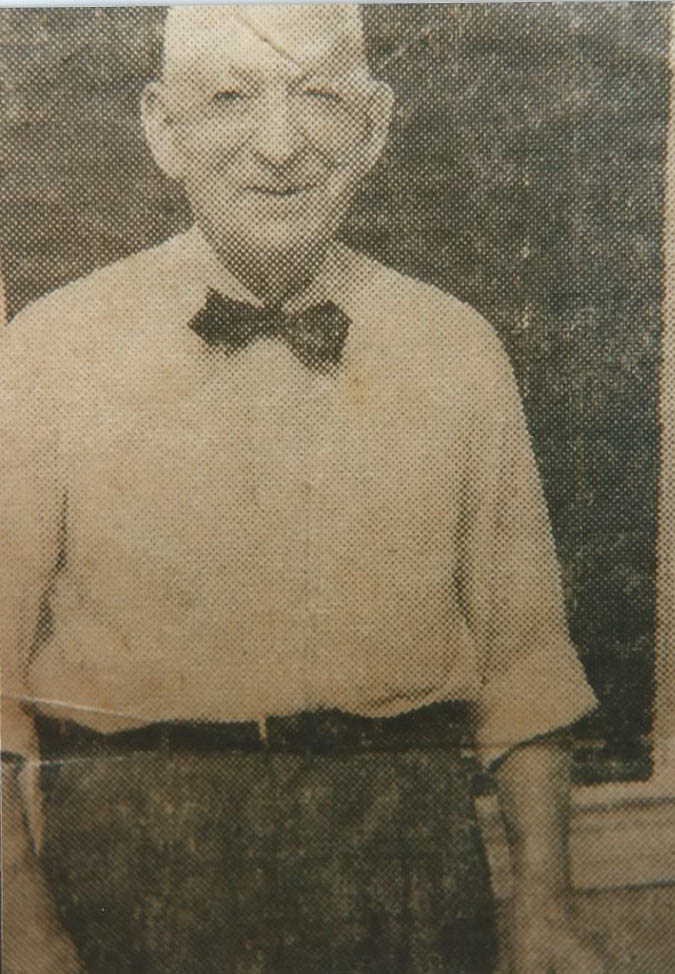
Some people leave behind boxes of letters, photographs, newspaper articles, and stories that are repeated around the family table for generations. Others leave behind a trail of records, scattered across census pages, city directories, draft cards, obituaries, and death certificates.
My great-great uncle, John Foster Choplin, was one of the latter.
At birth, his given name was Foster Choplin. According to my grandpa’s notes, he decided to add “John” at some point along the way. As best as I can tell, he added it around the time he moved to Virginia. Although there are still large gaps in his story, I have been able to piece together most of his life. Those gaps are especially noticeable when it comes to his childhood and his relationship with his father. What I have found, however, gives me a glimpse into a man who was born in the rural Harricanes of North Carolina and eventually made a permanent life for himself in Portsmouth, Virginia, working for decades at the Norfolk Naval Shipyard.
And perhaps most interesting of all, his life seems to have crossed a boundary that was both geographical and cultural. He was born into a complicated family situation in rural Granville County, yet as a young man he left North Carolina behind and made his home in a busy Virginia port city.
The Boy Called Foster
John Foster Choplin was born on August 12, 1876, according to the family information I have found, although his exact date of birth is not yet firmly established by a surviving record.
His mother was France’s Tyson “Ticy”/“Ticy Ann” Choplin, who was about 30 years old, and his father was Allen Davis, who was 41.
Foster was the second child born to Ticy and Allen, the first being Genadious.
His birth came under circumstances that would have been complicated and potentially scandalous in nineteenth-century North Carolina. Ticy and Allen were never married. Allen was already married to Lucretia Joplin, who happened to be Ticy’s aunt. Allen continued having children with Lucretia while also having children with Ticy.
Just a year after Foster’s birth, on July 14, 1877, his younger brother was born. That boy would become my great-grandfather, James Walter Choplin.
Then, on June 13, 1880, Foster’s half-brother, Fannie Andrew Davis, was born. Foster was about three years old.
Foster would eventually have seven full siblings and eight half-siblings. That is a large family, but it was not necessarily a family that could openly live as one.
A Family Hidden in the Records
One of the most striking things about researching Foster and his brothers is how difficult it is to find them during their childhood years.
Ticy and her boys do not appear in the census records when I would expect them to. They essentially disappear from the paper trail until the early 1900s.
I believe this may have been intentional.
At the time, children born outside of marriage could carry a tremendous amount of stigma. There could also be legal and financial concerns surrounding what was known as a Bastardly Bond, a mechanism used in North Carolina to address the financial responsibility for children born outside of marriage.
I cannot prove that this was the reason Ticy and her children were absent from the census records. But the circumstances make me wonder if an effort was made to keep the children hidden from public scrutiny.
Ticy and her eight boys are believed to have lived somewhere on the Davis property. I suspect they grew up on the same property the Choplin Homeplace is located. The property the Choplin Homeplace is located on was gifted to Ticy and her boys by Allen Davis; 200 acres. That means Foster and his brothers may have grown up remarkably close to their half-siblings, even if their family relationships could not be openly acknowledged in the way we might expect today.
I often wonder what that childhood looked like.
Did Foster and his half-siblings play together?
Did they know exactly who they were to one another?
Were Ticy’s boys treated differently?
Were they shunned by members of the family or the community?
Or was the situation simply understood within the family, even if nobody talked about it outside the household?
There is no record that can answer those questions.
What we do know is that the lines between the two families did not remain completely separate. Some of Foster’s brothers would eventually live with their half-siblings as adults.
Whatever happened during their childhood, those relationships seem to have endured in some form.
Leaving the Harricanes
The first record I have found that gives us a glimpse of Foster as a young man places him far from the rural community where he was born.
Foster moved to Norfolk, Virginia sometime before 1900. When he was about 27 years old, Foster appeared in a Norfolk, Virginia city directory. His occupation was listed as gate operator, although the directory does not tell us who employed him.
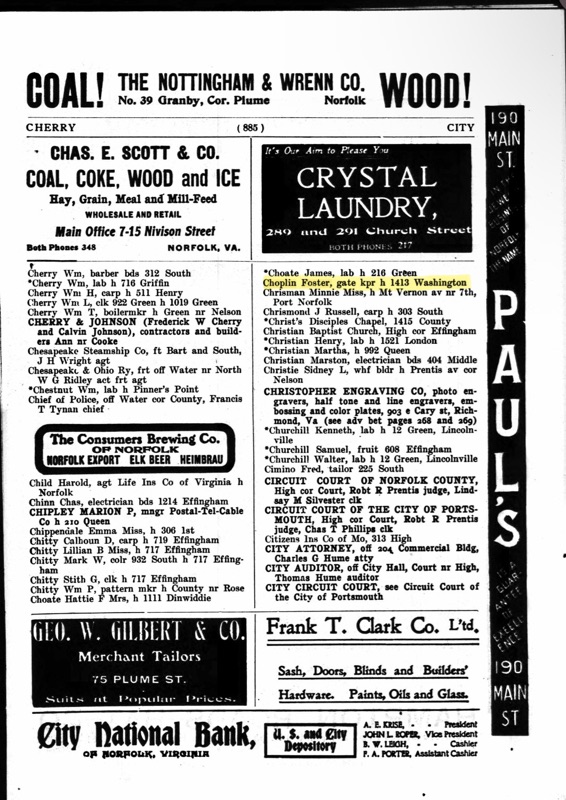
That simple entry represents a remarkable change in his life.
Foster had grown up in the Harricanes, long before the area became known by the nickname we use today. It was an extremely rural part of North Carolina, a world of farms, dirt roads, and close-knit communities.
Norfolk would have been something entirely different.
A city.
A major port.
Ships.
Factories.
Crowds of people.
And a world that was increasingly connected to the machinery and industry of the modern era.
I can only imagine what it must have been like for a young man from rural Granville County to arrive in Norfolk.
It is unclear exactly when Foster made the move or precisely how he got there, but I suspect he probably traveled by train. Whatever route he took, the move was not temporary.
Virginia became Foster’s home for the rest of his life.
The Death of His Father
In 1906, Foster’s father, Allen Davis, died.
This is one of the places where the records leave me with more questions than answers.
Foster’s relationship with his father is something I will probably never know for certain.
The parentage of Ticy’s boys was something that may have carried shame or embarrassment for the family. Their circumstances were not something that could easily be discussed in the same way we would discuss them today.
But did Foster have a relationship with Allen?
Did he see him regularly?
Did Allen acknowledge him as his son?
Did Foster consider Allen his father despite the complicated circumstances of his birth?
And when Allen died, did Foster return to North Carolina for the funeral?
For most of us, losing a parent is a profound event. But what did the death of Allen mean to Foster?
Was he grieving a father he loved?
Was he mourning a relationship that had never been what he wanted it to be?
Or had years and distance already created a separation between them?
Those are questions that the surviving records cannot answer.
Life in Portsmouth
By the 1910 census, Foster was living in Virginia and boarding with several other people. He was working at the Norfolk Naval Shipyard.
His life had taken another turn.
The young man who had once been listed as a gate operator was now working in one of the region’s major industrial workplaces.
His 1918 World War I draft registration card gives us one of the rare physical descriptions we have of him. Foster was described as having a medium build, medium height, light colored hair, and blue eyes.
For a moment, the paper record allows us to picture him as a young man.
That same year, in November 1918, the Creedmoor Times reported in its gossip section that Uncle Foster had returned home to visit family.
It is a small newspaper mention, but I love finding things like this.
It tells us that despite living in Virginia, Foster had not completely disappeared from his North Carolina family.
He came home.
Someone knew he had come.
And someone thought it was worth mentioning in the local newspaper.
A Worker at the Shipyard
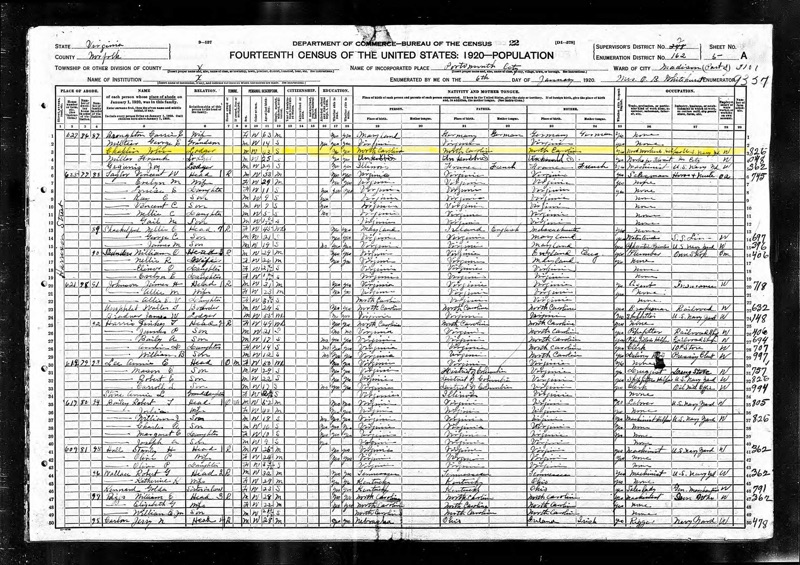
The 1920 census, finds Foster still living in a boarding house, this time on Harrison Street in Portsmouth City.
He was still working at the Norfolk Naval Shipyard, but his occupation had changed. He was listed as a woodworker’s helper.
Foster appears to have lived a fairly simple life. I have not found evidence that he ever married or had children of his own. Instead, the records repeatedly place him among other working people, living in boarding houses or with other families.
Then comes another gap.
I have not been able to locate Foster in the 1930 census.
That does not necessarily mean he left Virginia.
Sometimes people simply disappear between census records because they were missed by the enumerator, were living in an unusual arrangement, or their name was recorded incorrectly.
There may also have been a very good reason for Foster to be back in North Carolina around this time.
In June 1930, his youngest brother, Ollie, died.
Then, just four months later, in October 1930, Foster’s mother, Ticy, died.
It seems entirely possible that Foster returned home to Granville County during this period to be with his family.
Perhaps he came for Ollie’s funeral.
Perhaps he came when his mother became ill.
Perhaps he stayed for both.
I cannot prove that this is why he is missing from the 1930 census, but it would make sense.
After all, even though Foster had built his life in Virginia, North Carolina was still where his family was.
Still Working
In 1939, Foster’s brother Henry died. Foster was mentioned in Henry’s obituary and was still listed as living in Portsmouth.
The following year, the 1940 census places Foster living with the Willie Lee family in Portsmouth. Willie Lee was a truck driver.
Foster was still working at the Naval Shipyard.
And remarkably, even at this stage of his life, he was still working 60 hours a week. By then, Foster had spent decades in Virginia.
The young man who had left the rural Harricanes had become a longtime Portsmouth resident and a veteran worker of the shipyard.
The records suggest a man who worked hard and stayed with it.
The Family Comes to Virginia
In 1948, Foster applied for Social Security at the age of 71 and was later listed as unable to work in the 1950 census.
It is unclear what caused him to stop working, although age seems a likely explanation.
The year 1950 also brought another interesting change in the family.
Foster’s brother William Eden Choplin and his wife moved to Portsmouth from High Point, North Carolina.
After all those years, Foster was no longer the only Choplin from his immediate family living in Portsmouth.
I wonder what that was like.
Did the brothers spend time together?
Did William and his wife visit Foster regularly?
Did Foster help them get settled?
Did they talk about the family they had left behind in North Carolina?
Again, the records are quiet.
But I like to imagine that having a brother nearby gave Foster a little piece of home in the city that had become his home.
The Name on the Death Certificate
Foster died in Portsmouth on November 23, 1959, following a brief illness.
He was 83 years old. It seems he lived with the Lee family until the very end.
Even in death, the records give us one final mystery.
His death certificate lists his father as William E. Choplin.
At first, I assumed this referred to Foster’s brother, William E. Choplin. But after digging deeper into the family, I believe there is another possibility.
William E. Choplin is Ticy’s father’s name, making him Foster’s maternal grandfather.
This may not have been an isolated mistake.
Several of Ticy’s sons appear to have listed William Eden Choplin as their father in various records. I believe this may have been an attempt to protect their mother and themselves from the stigma attached to being born outside of marriage.
If that is what happened, it adds another layer to Foster’s story.
For decades, the truth about his parentage may have been something the family knew but the official records did not always reveal.
The records may have hidden the story.
But they also left clues.
A Life Far From Home
So much of Uncle Foster’s life remains unknown. We may never know exactly what his relationship with his father was like, how he felt about growing up in such a complicated family, or what prompted him to leave North Carolina. But the records do give us pieces of the life he built for himself.
He worked, he lived among other families and boarders, he returned home to visit his family, and he remained connected to his brothers and mother even after making Virginia his permanent home.
Foster died in Portsmouth on Monday November 23, 1959, at 4:15pm at the age of 83. He is buried in the Olive Branch Cemetery located in Portsmouth, Virginia.
There are still unanswered questions in his story, but I am grateful for the records that survived. Each one gives me another small glimpse into the life of a man who might otherwise have been little more than a name in our family tree.


Comments
Post a Comment