Allen Davis: The Soldier, Husband, & Father of Two Families -- Part II
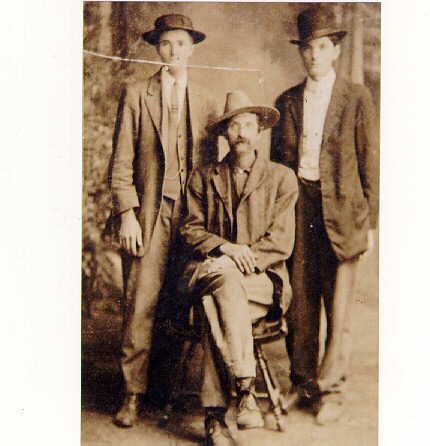
In 1860 Allen Davis was living a pretty normal life for a young farmer. A newly wed, he and his wife Seny were beginning to start their family, working their land, and probably assuming the next few years would look a lot like the last.
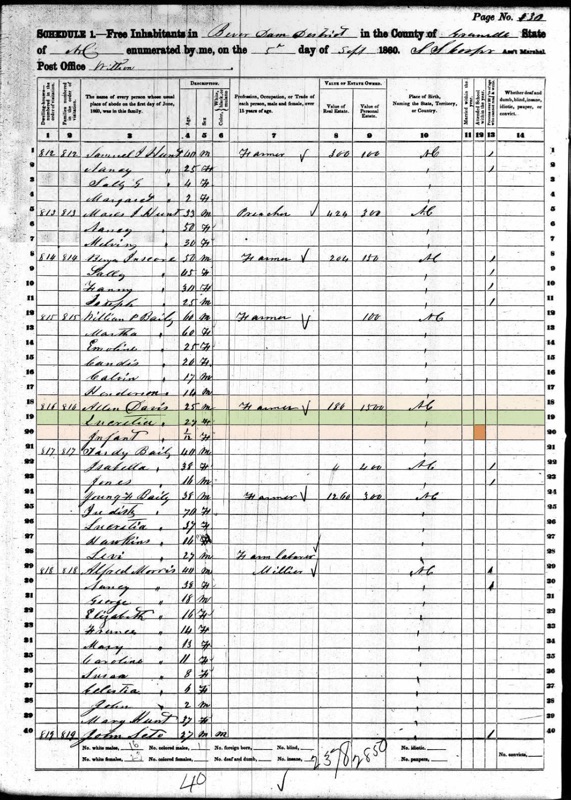
The first great loss of Allen and Seny‘s marriage came early on for the newly weds. When the 1860 census was taken on September 5th, the couple had a one month old daughter. She did not survive infancy. No record explains what took her, only the understanding that in an era before modern medicine, loss like this was heartbreakingly common.
In the mid-1800s, roughly one and five children did not live to see their first birthday. Poor families like Allen and Seny’s, grief was woven into daily life. Yet, life pressed forward.
The 1860 census also captured a snapshot of Allen‘s life just before the world changed. At 25, he was listed as a farmer with $180 in real estate and $1500 in personal estate, (which probably included the value of their slaves)a modest but stable footing for a young family in Granville County. The 1860 US Federal census slave schedule also places Allen among the counties slaveholders. Listing only the ages of the four enslaved people he owned. It’s a stark reminder of the economic and social structure Allen was part of, and the reality that his households labor and livelihood likely dependent on the institution of slave slavery. Within just a few years, the war would upend all of it.
North Carolina Goes To War
By 1861, the United States was at war with itself. North Carolina initially resisted joining the conflict, but after President Abraham Lincoln called for troops following the attack on Fort Sumter, the state’s position shifted rapidly. On May 20, 1861, North Carolina formally seceded from the Union. What had once felt like distant political debate quickly became a personal reckoning for families across Granville County.
Men began leaving home and increasing numbers. Some volunteered out of loyalty to their state, others under pressure from neighbors and kin. Many believed the war would be short, unable to imagine the scale of loss ahead. Women, meanwhile, found themselves running farms, raising children alone, and learning to live with uncertainty as a constant companion.
 WRAL story about earthworks in Raleigh.
..***Research Note: The movements and engagements that follow are based on my research into the history and wartime movement of the 55th NC Infantry. While these records help establish where the regiment was and what it was involved in, I cannot confirm that Allen Davis personally participated in every event described below. His individual records do not provide enough detail to establish his presence at each engagement. It is likely, however, that Allen participated in some, if not all, of these movements and and actions as a member of Company I, NC 55th
Allen Enlists
By the fall of 1862, the war could no longer be ignored. On October 2, 1860 27-year-old Allen Davis left home for Camp Mangum in Raleigh, where he enlisted in Company I known as the Franklin County Boys of the 55th North Carolina infantry regiment for a three-year term. He left behind a pregnant wife and no reliable way for her to know when, or if, he would return. By then, the regiment had already been organized for several months. Allen was joining men who had been serving since the spring. With Allen joining the military months after the war between the states had begun, it's likely he was not as eager about the war as some were.
The paragraph above reflects what Allen’s official military records document. But long before I ever began this genealogy work, my papa gathered stories from older relatives and collected notes from people who actually knew Allen. According to those accounts, Allen first traveled to Louisburg and then continued on to Camp Mangum with a group of local men. Considering that Company I carried the nickname “Franklin County Boys,” the tradition Papa recorded aligns closely with how enlistment often happened in this region and is likely a more accurate reflection of Allen’s actual journey.
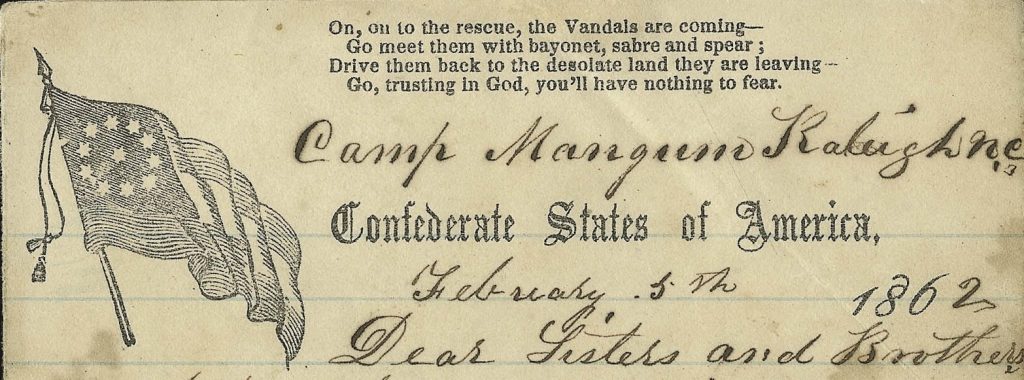
Camp Mangum was one of several training camps established to prepare North Carolina troops for Confederate service. Camp life was demanding. Soldiers drilled for hours each day, performed guard duty, and lived in crowded quarters where disease spread quickly.
For Allen, enlistment meant stepping into a world governed by orders, drills, and long marches. For Seny, it meant learning how to run a household alone in a time of scarcity and fear.
There were no telephones in the mid 1860s. Alexander Graham Bell’s first successful phone call wouldn’t occur until 1876. Communication depended entirely on letters or “snail mail” as we call it today. Those letters could take weeks or months to arrive, if they arrived at all. Once Allen marched away, Seny had no way of knowing where he was sent, what battles he might fight, or whether he was even still alive.
Winter In Petersburg
Allen‘s time at Camp Mangum was short. By the first week of October 1862, the regiment arrived in Petersburg, Virginia, setting up Camp French. They spent their first few weeks, digging earthworks and dodging occasional artillery fire from union gun boats on the river.
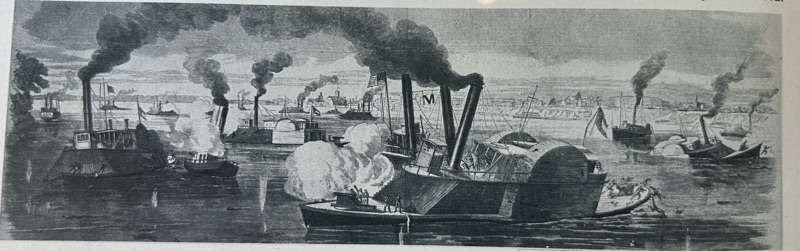
Soon, the 55th was assigned to provost duty, essentially acting as the military police for the bustling city of Petersburg. For a young soldier, city life brought unprecedented experiences. Allen walked 24 hour shifts patrolling the dark streets, dealing with rowdy, wartime drunks, and the cities thriving prostitution trade. Petersburg had become a well-known hub for brothels, and venereal diseases heavily impacted the regiment. Medical logs recorded a massive spike in gonorrhea cases throughout the winter. In fact, the red-light district knocked more men out of commission than the Yankees did that season.
There were brief moments of comfort. On October 29, they moved to the Model Farm west of the city, where they slept indoors with brick chimneys which helped keep them warm. One soldier wrote home that their room held 96 men, with only two men to a bunk, a massive luxury compared to sleeping on frozen ground.
But as winter deep end, the brutal reality set in. Diseases like mumps, typhoid, and smallpox tore through the camp, leaving only 466 out of 814 men fit for duty by late November. To make matters worse, the men were completely unequipped. By mid-December, the regiment Adjutant wrote a desperate letter to a North Carolina newspaper, pleading for blankets and clothes, describing the soldiers as “barefoot and naked for they want of clothes” their feet bleeding from the frozen mud. Shockingly, when winter clothes finally arrived in February, the cash-strapped confederate government docked the soldiers’ pay for items that patriotic North Carolina women had donated.
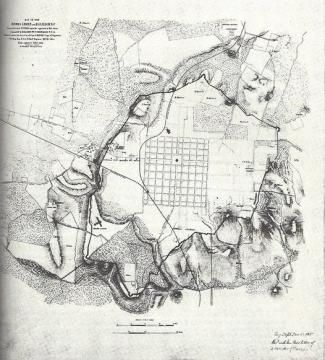
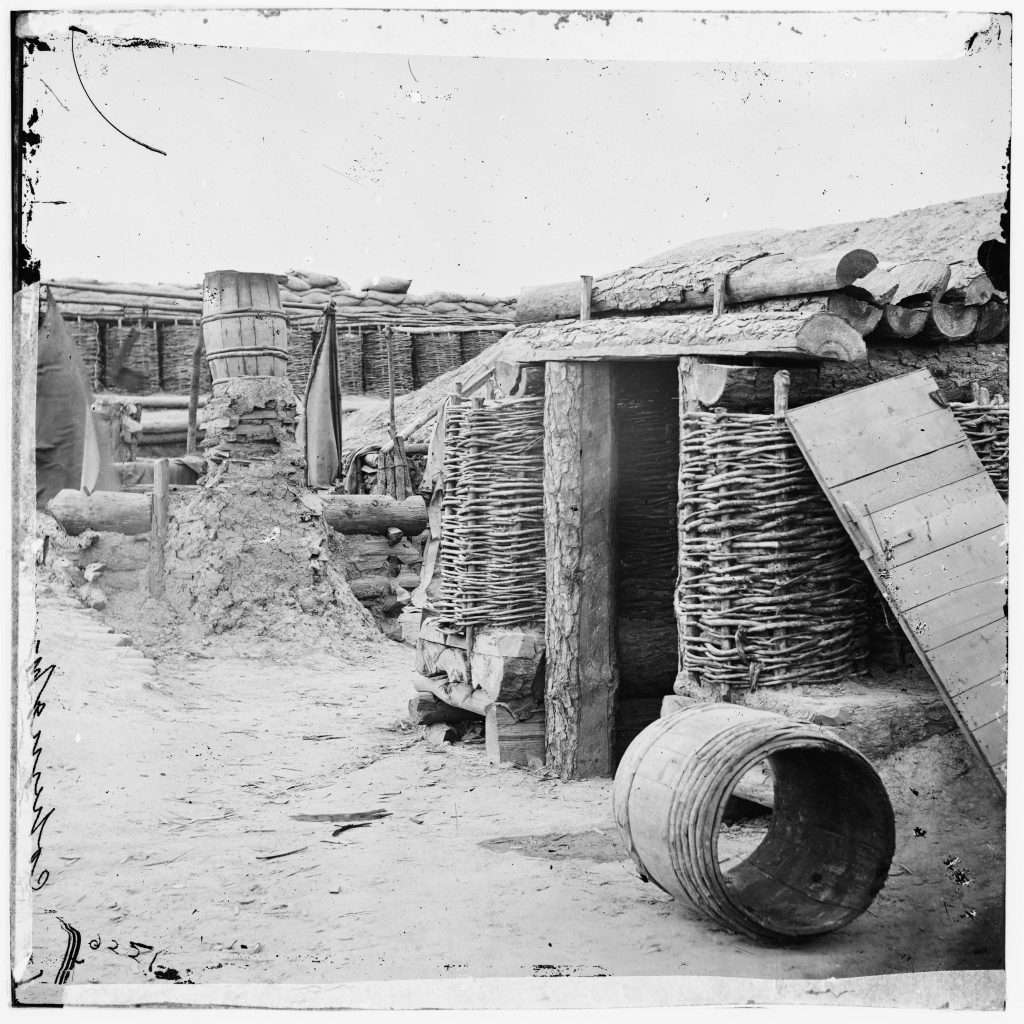 Confederate Fortifications outside Petersburg
The Left Wing and the March to Blackwater
In March 1863, the 55th was finally relieved of police duty and thrust into active field operations. They were ordered to the Blackwater River line to protect Richmond‘s vital railroad supply routes against a massive Union force at Newport News that outnumbered them three to one.
During this transition, the regiment re-organized for battle. The companies were split into two wings, company I was placed squarely in the left wing under Major Horatio, A. Belo. When lined up for battle, my Allen stood near the middle to the left of the line, sandwich directly between Company D and Company G.
The transition to the field was exhausting. Rations were slashed to a single pound of flour and a quarter pound of fat meat per day. Private Wilkerson complained bitterly in letters home, writing that the men were “constantly on the move” and “I’ll get killed marching so much.”
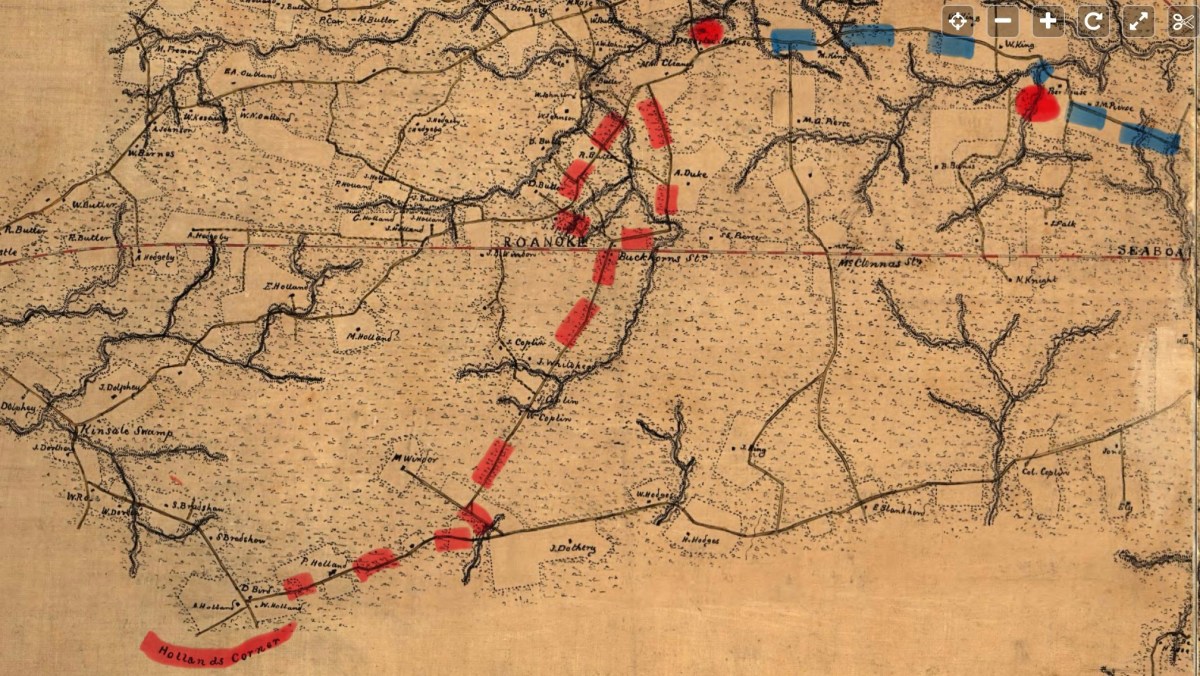
Under Fire at the Siege of Suffolk

On April 11, 1863 the 55th crossed the Blackwater River on pontoon bridges and advanced into enemy territory, beginning the Siege of Suffolk, Virginia.
On April 17, the regiment faced a major crisis at Hill's Point when Union gun boats began heavily bombarding the shoreline. In a moment of high stakes, Colonel Connolly ordered three companies, led independently by Captain William H. Williams of Company I, to rush to the front line at Norfleet's House to protect the vital artillery batteries. Allen was directly in this frontline detachment, staring down the barrels of Union gunboats.
Two days later, on April 19th disaster struck. A sudden Union amphibious assault captured a neighboring battery, throwing the confederate line into chaos. In the pitch black night, under a “furious“ crossfire of grapeshot and exploding naval shells, Major Bello, the left-wing commander, was ordered to form a second line of battle to stabilize the retreat. Allen, and his comrades spent the entire night shifting positions in the dark and mud, dodging relentless Federal shells. Miraculously, despite the wall of flying metal, not a single member of the 55th was killed that night.
Fighting For Their Honor: The Double Duel
During that night’s chaos, the battery fell to Union forces. For Allen’s company, there was simply nothing they could have done differently. They were outnumbered, fighting in the dark, and trying to hold a collapsing line together with sheer willpower. But by sunrise, logic had left the building. The rest of the regiment decided Company I must be to blame, and soon the men were arguing among themselves like brothers stuck in the same wagon for too long.
And in the 1860s, when men got truly offended, they didn’t sit down and talk it out. Oh no. They fought like “gentlemen.”
Which, of course, meant a duel.
Personally, I find this whole “gentlemanly combat” tradition about as sensible as lining up shoulder‑to‑shoulder in high-viz uniforms and shooting at each other in broad daylight, but that’s exactly what they did. Honor demanded it…apparently.
Colonel John Kerr Connally of the 55th North Carolina confronted the officers who’d insulted his men, and somehow this escalated into a formal challenge to a duel. But not just any duel — a double duel. Two officers from each side were expected to participate. Because if you’re going to do something ill‑advised, why not double it?
In the first corner representing the 55th North Carolina were:
Major Alfred Horatio Belo
Colonel John Kerr Connally
In the opposite corner representing Mississippi Infantry Units were:
Captain John Cussons
Colonel Lewis R. Terrell
So, on the morning of April 21st, the entire regiment gathered in an open field to watch the entertainment for the day.
Major Belo and Captain Cussons stood back‑to‑back, then paced away until forty paces were counted off. I can practically see the regiment standing on each side of the men, holding their breath, waiting to see if their officers were about to actually shoot each other dead over an insult.
Belo turned, Mississippi rifle in hand. Cussons did the same.
BAM!
Two shots cracked across the field.
Belo’s bullet hit first, punching a clean hole straight through Cussons’ hat — a near miss that probably made half the regiment gasp. Cussons’ shot grazed Belo’s neck, close enough to draw blood but not enough to drop him. Belo stood there stunned, while Cussons’, in true Cussons fashion, laughed off the whole thing and joked about their “poor shooting.”
Meanwhile, 150 yards away, Colonel Connally stood ready with a double‑barreled shotgun for his own duel with Colonel Terrell, silently thanking God that Belo and Cussons had ended theirs with a handshake instead of a funeral.
In the end, the duel accomplished exactly what the officers hoped: the men gained a renewed respect for their leaders. The officers had literally bled to defend the regiment’s honor. And for soldiers who had endured starvation, disease, and constant danger, that meant everything.
Walking Ghost
The Suffolk campaign ended in early May 1863. The 55th in North Carolina held the line against a massive union probe on May 1st, enduring a bombardment so terrifying that veterans decades later remarked it was worse than anything they had ever seen. Making matters more incredible, the 55th was the only regiment on the line still armed with obsolete, short range, smooth, or musket.
By the time they prepared to pull out of the trenches on May 3rd, the men were unrecognizable. Severely sunburned, emaciated from dysentery, and wearing tattered clothes, they looked like walking ghost. One soldier noted that when his own brother came to visit the camp, he walked right past him without recognizing his face.
They were starved, outgunned, physically broken, but their honor was completely intact. And ahead of them lay a march northward toward a small crossroads town in Pennsylvania that would cement their names in history forever.: Gettysburg.


Comments
Post a Comment