Grover Cleveland Rogers: An Orphan, Husband, and Father
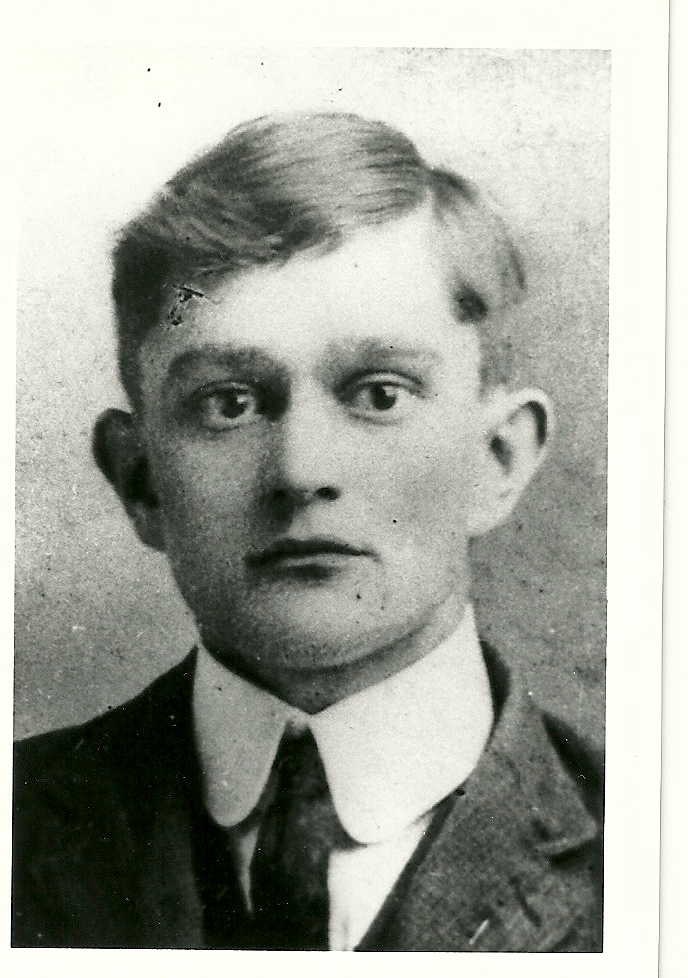
Grover Cleveland Rogers (1884-1925): An Orphan, A Husband, A Father
1885 – Grover Cleveland begins his second term as President.
1886 – Coca-Cola is introduced in Atlanta, Georgia.
1887 – Eiffel Tower construction begins.
1888 – Frederick Douglass is nominated for Vice President.
1889 – Four new states join the Union.
Grover Cleveland Rogers was born on May 20, 1884, in the area of Franklin County that would later become known as the Harricanes. He was the son of Edris Burkley Rogers, age 32, and Virginia "Jinnie" Hockaday Rogers, age 34. By the early 1900s, Grover was going almost exclusively by his middle name, Cleveland. He never strayed far from the place where he was born, spending his entire life in the communities surrounding the Harricanes.
Cleveland's childhood was marked by tragedy. His mother died when he was nine years old, and his father followed shortly thereafter. While the records tell us when they died, they do not tell us why. As I continued researching Cleveland's life, I discovered clues that may eventually provide an answer to that mystery.
Orphaned at a Young Age
Grover’s childhood was marked by tragedy.
1890 – Idaho becomes the 43rd state.
1891 – Carnegie Hall opens in New York City.
1892 – Ellis Island opens as an immigration station.
1893 – Thomas Edison completes the first movie studio.
1894 – Coca-Cola is sold in bottles for the first time.
Those ten years were the only years he would ever know with his complete family together.
I have not been able to locate a will for Edris Rogers, and that left me wondering: What happened to Grover after his parents died? Where did he live? Who cared for him?
While we will never know exactly how events unfolded, the records provide clues.
At the time of her father’s death, Grover’s oldest sister, Ada Rogers, was seventeen years old. As the eldest child, I believe she likely assumed responsibility for helping care for her younger siblings. It would not have been an easy burden for a teenager, but the evidence suggests she stepped into that role when her family needed her most. Some of their fathers siblings lived in the area
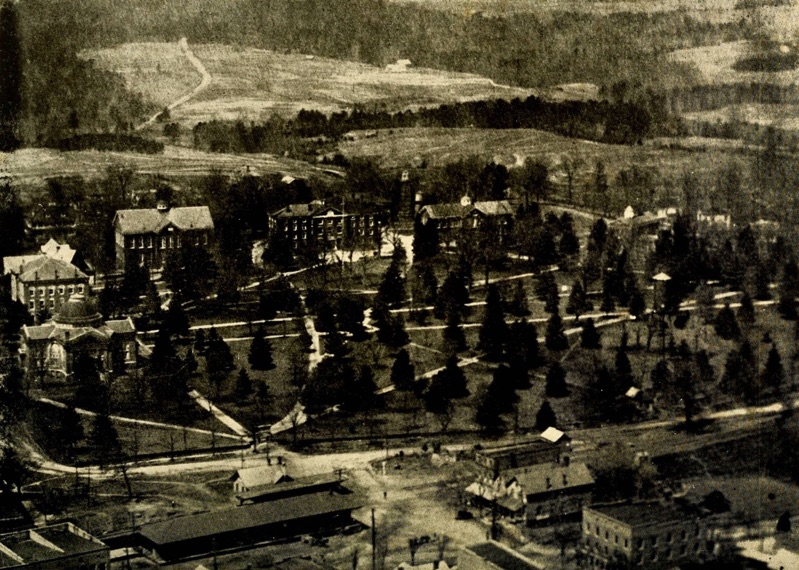
1920s aerial view of Wake Forest
Following His Sister
In 1895, Ada married Dudley J. Fuller of Brassfield Township in neighboring Granville County.
1895 – William Morgan introduces "Mintonette," later renamed volleyball.
1896 – Utah becomes the 45th state.
1897 – William McKinley is inaugurated as the 25th President.
1898 – The United States declares war on Spain, beginning the Spanish-American War.
1899 – Humphrey O'Sullivan patents the first rubber shoe heel.
The 1900 census provides a fascinating glimpse into these family connections. Ada was living in Oxford with her husband and children. Also residing in the household was her sister Clara.
After some digging, I was able to locate Grover as well.
He wwas living in Wilton, a small crossroads community just south of Oxford. Interestingly, he appears on the census not as Grover, but as Cleveland. At sixteen years old, he was living in the household of John C. Fuller and was listed as a servant.
This discovery immediately raised another question. Ada had married Dudley Fuller, while Grover was living with John Fuller. Were John and Dudley related? I have not yet been able to make that connection, but it seems likely they were at least distant relatives.
Whatever the exact relationship, the arrangement suggests that Ada helped ensure her younger brother was cared for after the loss of their parents. How long Grover remained with the Fuller family is unknown, but the next record we find places him on the threshold of starting a family of his own.
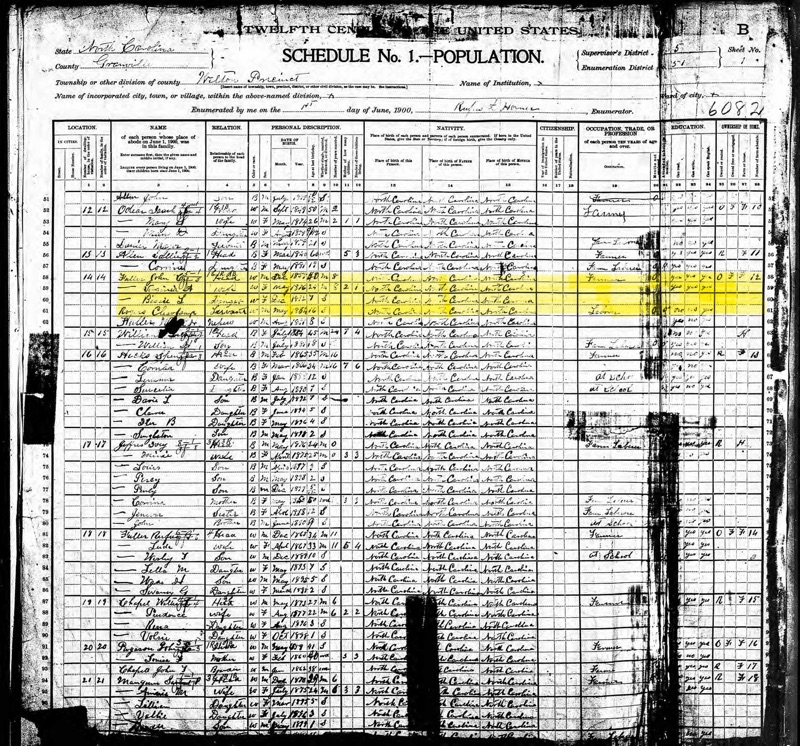
1900 census record
Meeting Mary Minerva Perry
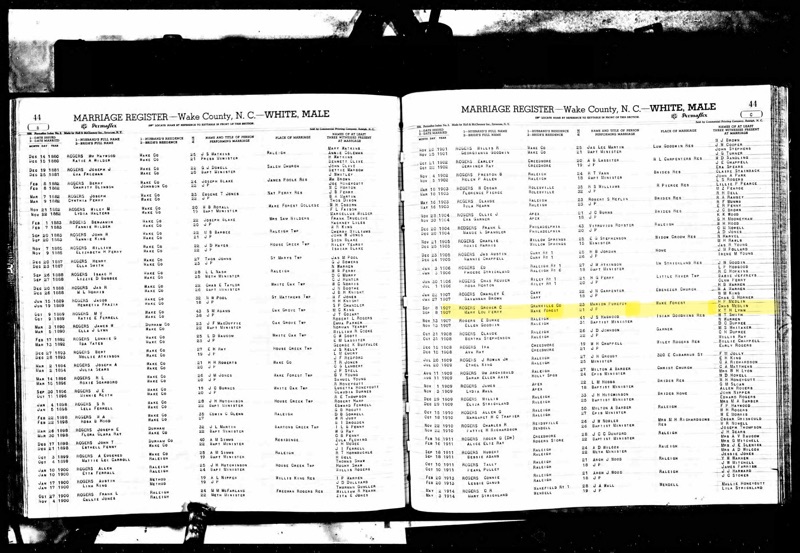
1900: First occurrence of the word “hillbilly” (NY Journal) 1901: William McKinley inaugurated for 2nd term & assonated 194 days later. VP Teddy Roosevelt becomes president 1902: Target corporation founded 1903: Wright Brothers fly 1904: 1st athletic letters given to seniors 1905: Albert Einstein publishes his quantum theory of light 1906: Kellogg’s founded 1907: Oklahoma becomes 46th state of USIn 1907, twenty-three-year-old Grover Cleveland Rogers married twenty-one-year-old Mary Minerva “Lou” Perry.
Do you recognize that surname?
Perry.
Yes, this is one of my connection to the prolific Perry family line.
One question I wish I could ask both of them is simple: How did you meet?
In 1900, Cleveland was living in Wilton, while Lou was living in Wake Forest. Today the distance may not seem significant, but in an era when the primary means of travel were horseback or horse-drawn carriage, they were not exactly neighbors. Most people married someone from their immediate community, making me even more curious about how these two first met. Somewhere along the way their paths crossed, and unfortunately that story did not survive the passage of time.
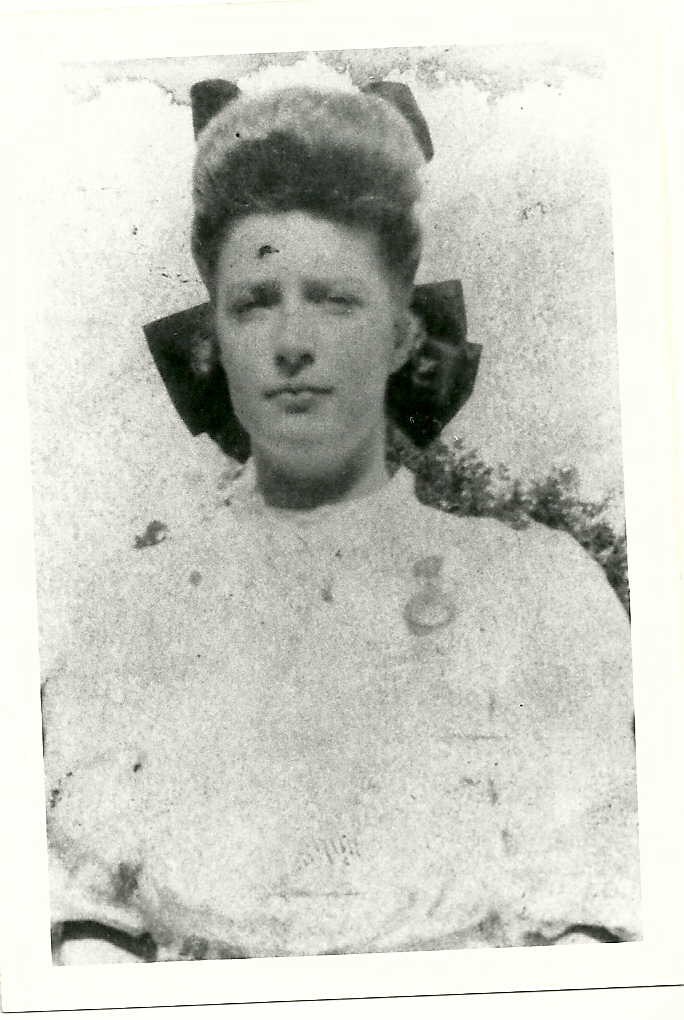
Mary Minerva Perry
Building a Family
1908 – The first Mother's Day is observed.
1909 – The NAACP is founded; William Howard Taft becomes President.
1910 – The first junior high school opens in California.
1911 – The U.S. Postal Savings System begins operation.
1912 – The Titanic sinks in the North Atlantic.
1913 – Grand Central Terminal opens in New York City; Woodrow Wilson becomes President.
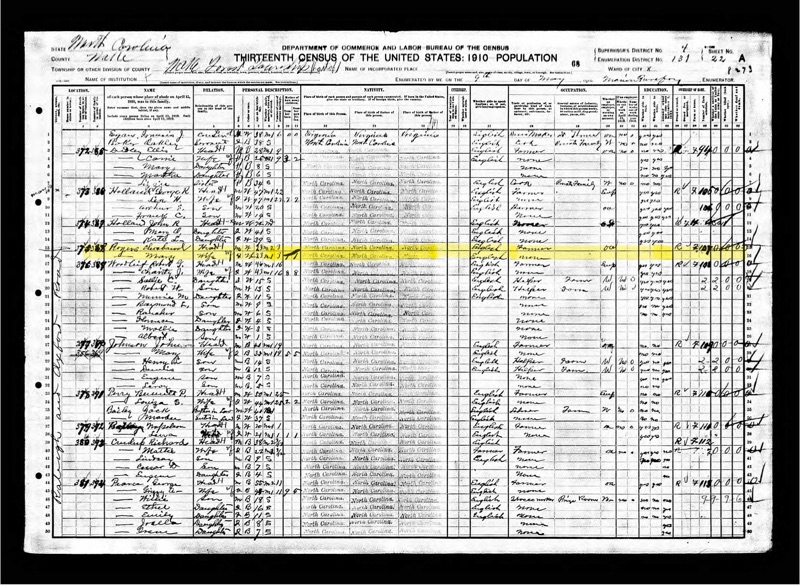
The 1910 census reports that the couple had one living child, although her name was not recorded. I believe this child was Pearl.
Her first name may have been chosen in honor of Grover’s mother, Virginia “Jinnie” Hockaday Rogers. Throughout her life, however, she was known simply as Pearl.
Aunt Pearl, as my mother remembered her.
The 1910 census shows Grover, now primarily going by Cleveland, living in Wake Forest near Lou’s parents, Bennett and Louisa “Lou” Perry. Having lost his parents at such a young age, Cleveland appears to have moved closer to his wife’s family and the support network they could provide.
Whether he remained close to his sisters is impossible to know, but given what they had endured together, I like to think they stayed connected.
Three years later, on July 24, 1913, the couple welcomed their second daughter, Goldie Louise Rogers. She was likely named after her maternal grandmother, Louisa Perry. Like her older sister, she would become known by a different name later in life. Family members remembered her as Myrtle, or Aunt Myrtle.
On January 22, 1915, their third daughter, Minnie Ada Rogers, was born. Her name was likely chosen in honor of Cleveland’s eldest sister, Ada.
Then came an event that must have transformed the household completely.
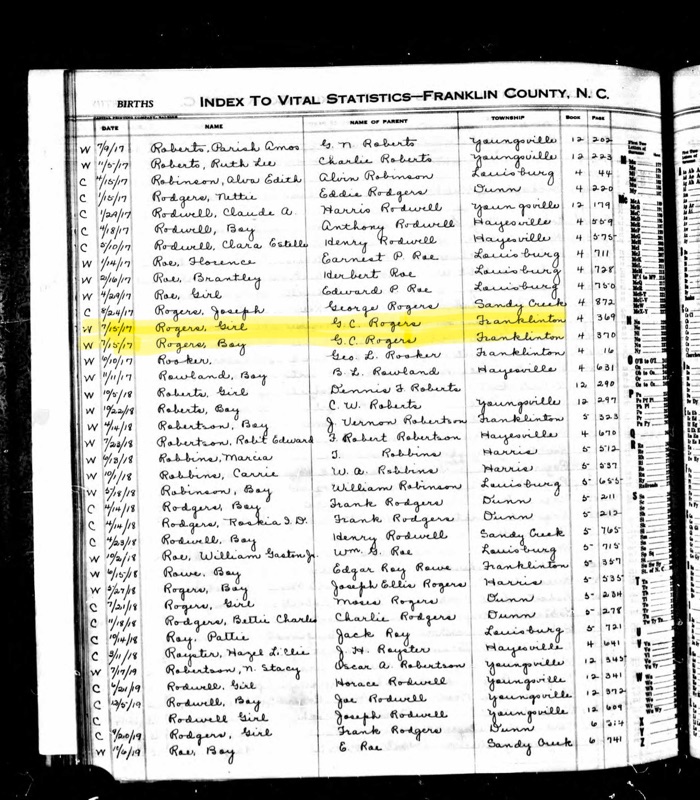
Twins!
1914: Assassination of Austrian Archduke Franz Ferdinand—WWI 1915: US Coast Guard established as branch of military 1916: Margaret Sanger opens first abortion clinic to limit the black race 1917: US formally enters WWI 1918: Spanish Flu In July 1917, Lou gave birth to twins, a boy and a girl.
Today parents often know months in advance that twins are on the way. In 1917 there were no ultrasounds, no prenatal imaging, and far fewer opportunities to monitor a pregnancy.
Did Lou suspect there were two babies?
Could she feel the difference?
Or was it a complete surprise when the second child arrived?
The twins, Clara Bessie Rogers (my great-grandmother) and Bennett Hester Rogers, appear to have been named for two important people in their lives. Clara likely honored Cleveland’s sister, while Bennett was almost certainly named after Lou’s father.
The naming patterns within this family tell a story all their own.
A Growing Household
1919 – Women's suffrage is approved by Congress.
1920 – Prohibition begins in the United States.
1921 – Warren G. Harding becomes President.
1922 – Construction begins on Yankee Stadium.
1923 – Calvin Coolidge is sworn in as President.
1924 – The first Macy's Thanksgiving Day Parade is held.
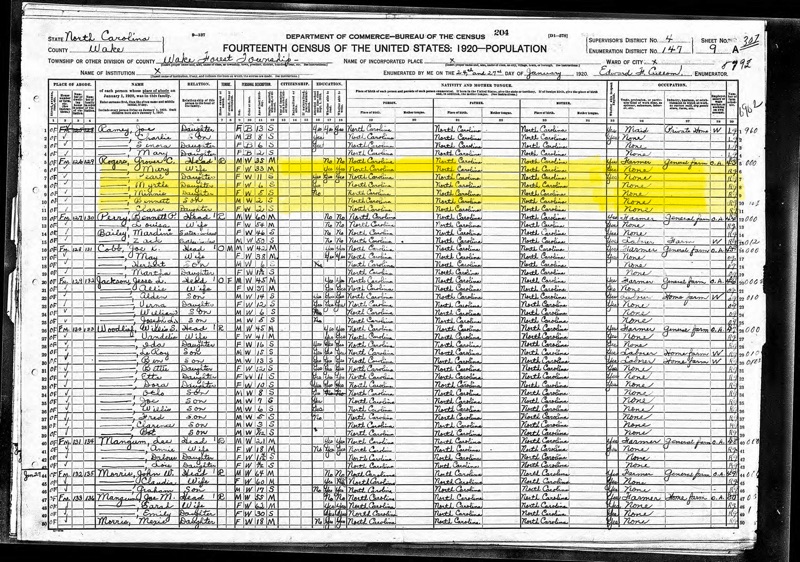
Interestingly, the census was taken in January 1920 while Lou was pregnant with their sixth child.
Just two months later, on March 22, 1920, Willie Elmo Rogers was born.
The following year, on November 17, 1921, the family welcomed their seventh child, Dudley Fuller Rogers.
His name immediately stood out to me.
Dudley Fuller was the husband of Cleveland’s oldest sister Ada, the very sister who I believe helped care for him after the deaths of their parents. Naming a son after Dudley suggests the Fuller family may have played an important role in Cleveland’s life during those difficult years.
Finally, on July 17, 1925, the couple welcomed their eighth and final child, Grover Cleveland Rogers Jr.
What strikes me most about this birth is that Cleveland waited until his eighth child and second son before naming a child after himself.
Many men of the era named their first son after themselves. Cleveland did not.
Instead, he spent years honoring the people who mattered most to him. His children carried the names of sisters, grandparents, and relatives who had shaped his life.
Only after honoring others did he pass on his own name.
Of course, I never knew my great-great-grandfather. But this pattern gives me a small glimpse into the kind of man he may have been. A man who put others before himself.
The Illness That Followed Him
1925 – The Grand Ole Opry begins broadcasting.
1926 – Route 66 is established.
1927 – The first non-stop transatlantic flight is completed.
1928 – Mickey Mouse makes his debut.
1929 – Herbert Hoover becomes President.
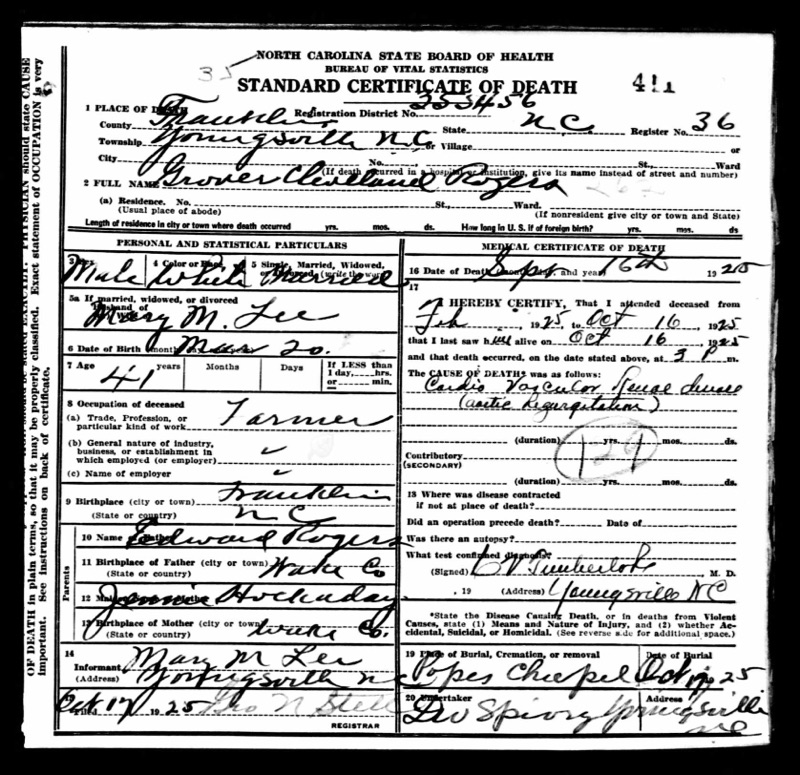
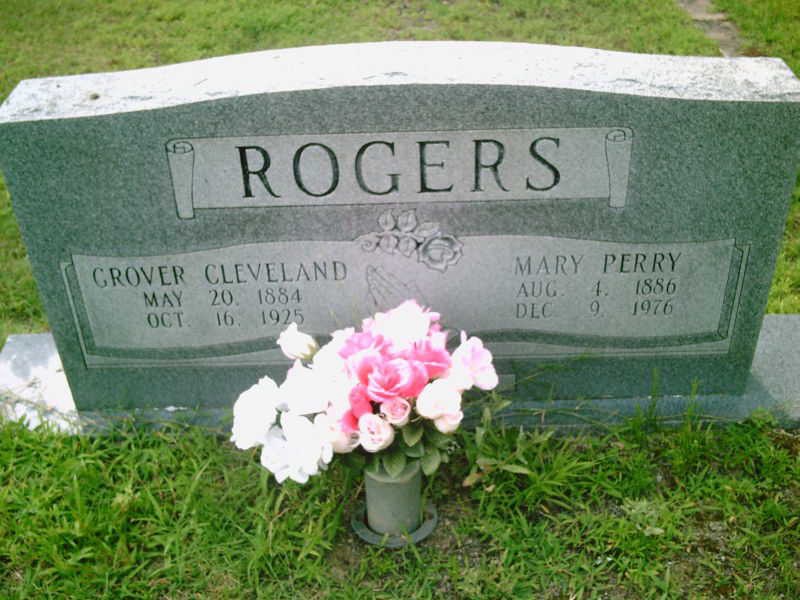
On October 16, 1925, only three months after the birth of his youngest son, Grover Cleveland Rogers Jr., Cleveland died in Youngsville, Franklin County, at the age of forty-one.
His death certificate lists cardiovascular renal disease with aortic regurgitation as the cause of death.
In modern terms, this indicates serious heart disease involving a damaged aortic valve. Such damage was frequently caused by rheumatic fever contracted years earlier, long before antibiotics existed. The disease gradually weakened the heart and was often fatal in the early twentieth century.
For me, this discovery answered one question while creating another.
At the beginning of Cleveland’s story, we are faced with the mystery of his parents’ deaths. Virginia “Jinnie” Hockaday Rogers died in 1893, and Edris Burkley Rogers followed the next year. Both died relatively young, leaving their children orphaned.
Could Cleveland’s death provide a clue to what happened to them?
Of course, no record has surfaced that identifies the exact cause of death for either parent. However, knowing that Cleveland likely suffered from rheumatic fever at some point in his youth opens an interesting possibility. Rheumatic fever often spread following untreated streptococcal infections and could affect multiple members of a household.
It is possible that the Rogers family experienced such an illness during Cleveland’s childhood. The children may have been young enough and strong enough to recover, while the disease proved far more dangerous for their parents. If that happened, Cleveland may have survived the initial illness only to carry its hidden damage for the rest of his life.
We will never know for certain if this is what happened. Yet the possibility creates a poignant connection between the beginning and end of Cleveland’s story. The same illness that may have orphaned him as a child could have quietly followed him for decades before ultimately claiming his life at age forty-one.
His widow, Mary Minerva Perry Rogers, never remarried. From the records I have found, she raised all eight children on her own.
The Rogers Family Today
Cleveland’s life may have been brief, but the family he and Mary Minerva created has continued to grow long after his death.
I have attempted to follow every branch of his family tree, though some descendants remain difficult to trace. Based on the records currently available, I estimate that Grover and Lou’s family grew to include:
• 8 children
• 15 grandchildren
• 23 great-grandchildren
• 22 great-great-grandchildren
• 17 great-great-great-grandchildren
Not bad for a little boy who lost both parents before reaching his tenth birthday.
His story is one of hardship, family, perseverance, and love. Though his life was brief, the family he built continues to grow more than a century after his birth.
Buried at Wale Union Baptist Church in Wale Forest, North Carolina


Comments
Post a Comment