Arthur Hodge (1885–1940): A Wake County Life Marked by Work, Loss, and Survival
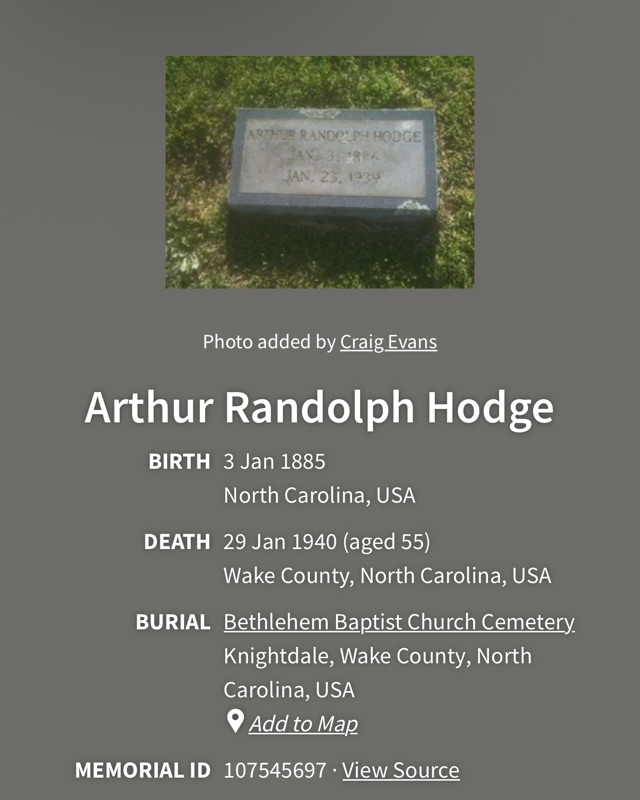
Arthur Hodge was born January 3, 1885, in Wake County, North Carolina, into a rural world of farms, dirt roads, and small communities that no longer exist as they once did. He lived his entire life in Wake County, passing away on January 23, 1940, but the story between those dates is anything but ordinary.
Arthur was the son of Nathan Ivey ‘Sam’ Hodge Sr. and Lenora “Nora” B. Parrish. By 1900, he appears in St. Matthew’s Township as a 15-year-old farm laborer already working, already literate, already carrying the responsibilities of adulthood.
Courting Vallie & an Elopement That Shocked the Family
At 22, Arthur married Valarie “Vallie” Helon Holder, who was only 16 years old. According to their daughter, Chloe Bell Hodge, Arthur and Vallie met at the parlor. Arthur courted Vallie properly; they walked to church together. They had never even kissed before marriage.
But Vallie’s parents did not approve.
The reason given was Arthur’s weekend drinking an objection that appears often in Wake County family stories of the era. Convinced marriage was the only way forward, Vallie quietly planned an elopement. Day by day, she slipped one article of clothing at a time to her best friend and neighbor’s house. When everything she needed was safely hidden, she told her parents she was spending the night with her friend. Instead, she slipped away with Arthur to Raleigh, where they were married by Justice of the Peace N. W. Poole.
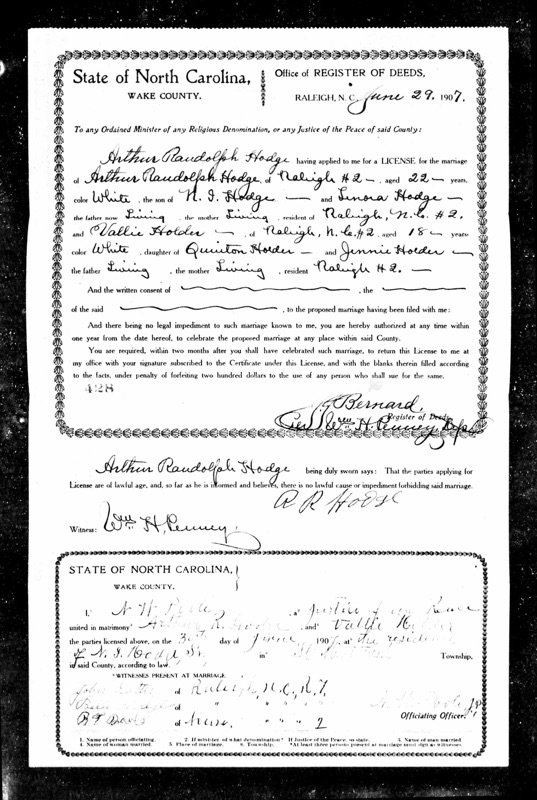
Poole is my maiden name. I have not yet identified how this man fits into my family tree, but in Wake County, coincidences like that are rarely coincidences.
A Violent Accident & a Past That Followed Him
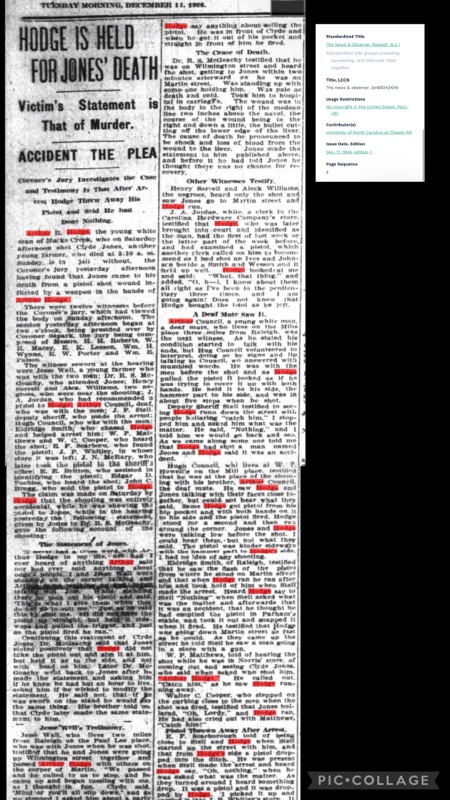
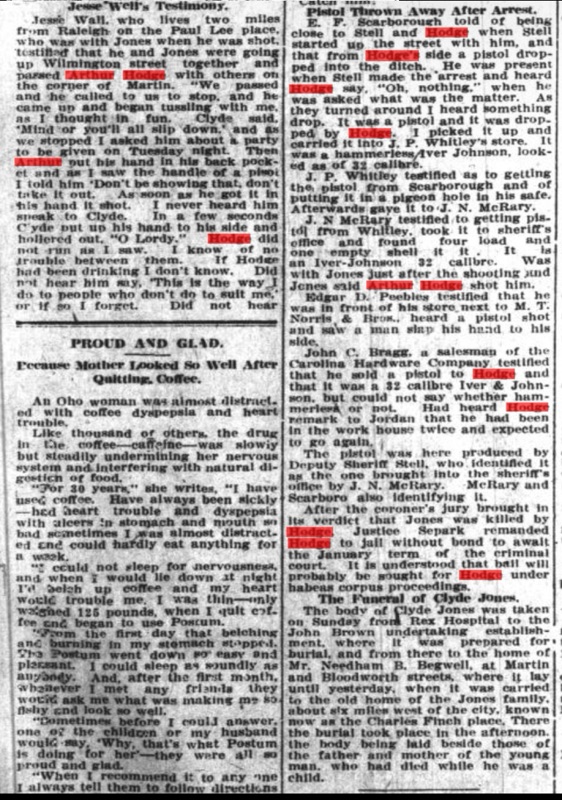
The News & Observer ran several articles involving Arthur Hodge during December of 1906. On December 8, 1906 Arthur purchased a new hammerless Iver & Johnson revolver from Carolina Hardware Company in downtown Raleigh. After showing it to friends, Arthur encountered his neighbor and lifelong friend, Clyde Jones, on Wilmington Street.
As Arthur pulled the gun from his pocket to show it off it discharged, striking Clyde in the stomach.
Arthur panicked and ran, discarding the weapon as he fled. He was intercepted by Deputy J. P. Stell and taken into custody. Clyde Jones later died from the wound.
Arthur was tried in January 1907. The jury concluded the shooting was a tragic accident between two lifelong friends. Arthur was acquitted of murder but convicted of carrying a concealed weapon and fined $100, a substantial penalty at the time.
Notably, Clyde Jones was an orphan taken in by Robert Poole, and the articles mention Clyde worked for a Mr. Holder the maiden name of Arthur’s future wife. It is difficult not to see how this incident would have reinforced Vallie’s parents’ objections.
My aunt never mentions this event in her book. I do not believe she knew.
Building a Family & a Livelihood
Between 1908 and 1916, Arthur and Vallie welcomed four children, all born in Wake County:
- Jasper ‘Jack’ Hodge: Born June 1908
- Thomas A. ‘Tom’ Hodge: Birn August 29, 1912
- Flonnie Clay Hodge: Born October 11, 1914 (my great-grandmother)
- Chloe Bell Hodge: Born July 30, 1916
Arthur worked as a farmer, mechanic, and sawmill laborer. In 1916 Arthur’s parents died within months of each other. Using money inherited after the deaths of his parents, he purchased partial ownership in a sawmill, an ambitious move for a rural Wake County man.
The 1920 census shows the family back in St. Matthew’s Township and includes an 18-year-old Black woman, Maud Candy, listed as a family servant.
Injury, Survival, and Vallie’s Strength
Around 1917 or 1918, Arthur suffered a severe sawmill accident, slicing his leg open near the knee. Blood poisoning nearly killed him. He was bedridden and unable to work for nearly two years.
During this time, Vallie became caregiver, provider, and nurse. Modern bandages did not exist; she used old linens, boiling and reusing them. Neighbors donated worn cloth. A doctor later credited Arthur’s survival not to medicine, but to Vallie’s care.
Arthur eventually regained the ability to walk but spent two years on crutches.
A Loss No Family Recovers From
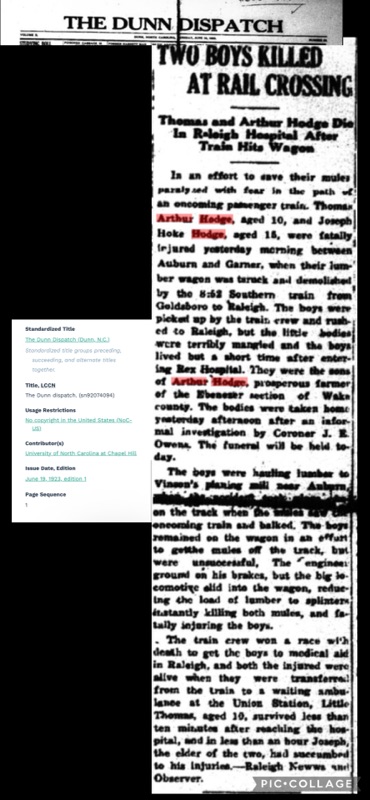
On June 16, 1923, tragedy struck the Hodge family again.
Arthur’s sons, Jack age 10, and Tom age 8, were helping move logs from the sawmill using a mule-drawn wagon. As they crossed a railroad track, an oncoming train approached. Fearful of their father’s reaction to losing the mule, the boys attempted to pull the animal off the tracks.
They were unsuccessful.
The train struck the wagon, killing both boys.
The accident occurred just days before Jack’s birthday. Vallie had been in their kitchen on Poole Road making an orange layer cake for him. She was understandably distraught—and she never made another orange layer cake for the rest of her life.
To compound the family’s grief, while they attended the funeral of their two sons, someone broke into their home and robbed them stealing Vallie’s only other dress.
It was later determined that the train failed to blow its horn as it approached the crossing.
Arthur would make several trips north to where the train company was based, pursuing legal action for negligence. Eventually, the company settled, paying Arthur $8,000, a significant sum at the time, though roughly half went to legal fees.
After this loss, Arthur stopped drinking completely.
A New Start Along the Neuse River
Arthur and Vallie were eager to leave Poole Road after the deaths of their sons. The following spring, they moved six miles north on Poole Road, near the banks of the Neuse River.
Using the remaining settlement funds, Arthur purchased two lots in the Fisher Heights community of Wake County. There, he began building a five-room bungalow for his family. As was common in that era, Arthur did most of the work himself.
Thinking ahead, Arthur hired someone to wire the house for electricity, even though electrical service had not yet reached the area.
This decision speaks volumes about Arthur’s desire to provide stability and modern comforts for his family after years of hardship.
Later Years: Stability and Redemption
After leaving the sawmill, Arthur secured employment with the State of North Carolina. The steady income made life noticeably easier for the family.
In time, Arthur became the favorite son-in-law of Vallie’s parents a quiet redemption after years of disapproval. Every Christmas, Arthur prepared a cardboard box filled with sweet treats for them, a tradition remembered long after his death.
Arthur and Vallie have not yet been located in the 1930 or 1940 censuses, despite Arthur’s death occurring in 1940, a mystery still under investigation. Around 1938 Arthur had several mini strokes and spent time in the hospital. It was around this time when Mormon missionaries were visiting Raleigh from Rocky Mount. Arthur was very impressed by the two missionaries and the whole family left the baptist church they had always gone to, Ebenezer Baptist Church and Bethlehem Baptist Church and joined The Church of Jesus Christ and Latter Day Saints. The Mormon religion was very new to Raleigh. There was no established church building or meeting house yet. Meetings were held at member’s homes. Arthur became too weak to travel to the meetings due to his declining health. To ensure Arthur continued growing his relationship with God and becoming more involved in the church, Arthur offered to host the weekly Bible studies at his house. In June of 1939 the whole family was baptized into the church. The Hodge family became one of few families that started the Raleigh division for The Church of Latter Day Saints. They would go go on to play a pivotal role in the church growing in the Raleigh area and becoming what it is today.

The Raleigh , North Carolina Temple
Arthur Hodge’s life was marked by hard work, tragedy, endurance, and quiet redemption. He was a man shaped by accident, loss, and responsibility, a husband who changed, a father who grieved, and a provider who thought ahead for a future he might never fully see.
His story lives in census records, newspaper ink, and the memories passed down by a daughter who may not have known all of it.


Comments
Post a Comment